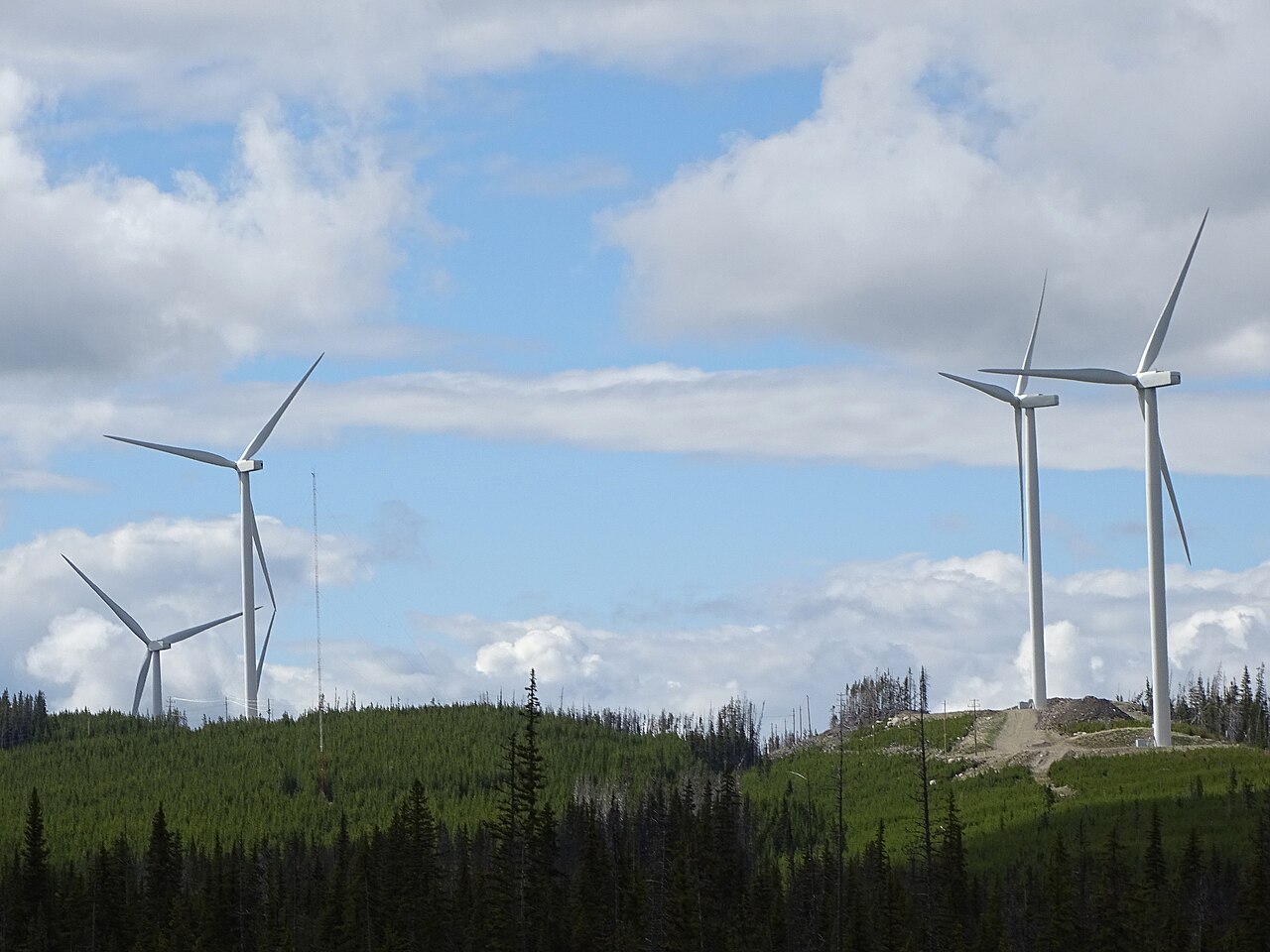
On July 2, 2026, PM Mark Carney and Premier David Eby announced the Canada-BC Cooperative Prosperity Agreement. Alongside LNG, port, and critical-minerals commitments, one line stands out: the two governments will explore developing a BC wind turbine manufacturing sector using Canadian steel. That's a small phrase with an outsized signal — Western Canada currently has none.
What's in the July 2 agreement
| Wind turbine manufacturing | Both governments will explore developing a BC sector using Canadian steel — first federal-provincial signal on this. |
| Cedar LNG, Ksi Lisims, Tilbury Phase 2 | Advanced or fast-tracked, alongside continued Port of Vancouver expansion. |
| Red Chris Mine expansion | And other critical-minerals projects — tied to the western/northern strategy signed earlier in 2026. |
| Faster permitting | "Major projects delivered faster" is the frame running through the whole document. |
Why the turbine question came up
In December 2025, Canada put a 25% tariff on imported steel-derivative products, including utility wind towers. Wind towers for projects west of the Manitoba-Ontario line were exempted — but the tariff surfaced a bigger issue: Canada has essentially one domestic wind-tower manufacturer, in Quebec, at a moment when BC is issuing major calls for new wind power. The July agreement's response is to explore building the capacity domestically.
Western Canada has zero wind turbine manufacturing today. That's about to become a live policy question.
Where BC manufacturing stands
The broader transition
Zoom out and five threads are converging at once:
01Raw material → finished product
02Forestry base → clean-tech re-tooling
03General → advanced manufacturing
04Individual plants → regional clusters
05Capital-first → workforce-first
What "advanced manufacturing" means here
The term gets used loosely. In this Canadian context it usually points at some mix of:
| Connected equipment | Sensors and IoT feeding live data on machine health, throughput, and quality. |
| Automation & robotics | Including cobots that work alongside operators rather than replacing them. |
| AI decision support | Predictive maintenance, quality inspection, demand forecasting. |
| Digital twins | Modeling plants and processes virtually before changing them physically. |
| Additive manufacturing | Industrial 3D printing for spares, tooling, and increasingly end-use parts. |
| Green manufacturing | Mass timber, electrified process heat, closed-loop material flows. |
What's already scheduled
What are you watching?
None of these are guaranteed. The Cooperative Prosperity Agreement is a framework, not a delivered outcome. What's genuinely new is that these pieces are all moving at once — and pointing, for the first time in a long time, in roughly the same direction.
Interested in how any of these threads land? Happy to compare notes.
Get in touch →Where these numbers and quotes come from
- Prime Minister of Canada, Canada-BC Cooperative Prosperity Partnership announcement (July 2, 2026)
- Prime Minister of Canada, Cooperative Prosperity Agreement backgrounder
- CBC News, BC-Ottawa economic agreement coverage
- Business in Vancouver, Federal wind tower tariff and BC's clean power push
- Government of Canada, 25% tariff on steel derivative products (Dec 26, 2025)
- Prime Minister of Canada, Team Canada Strong — 100,000 skilled trades workers (April 2026)
- Province of BC, Manufacturing in British Columbia fact sheet
- ISED Canada, Economic Strategy Tables — Advanced Manufacturing